Myanmar’s historic moment

Today has been a landmark moment in Myanmar’s history: the first openly contested elections in Myanmar since 1990 when nobel laureate Aung San Suu Kyi won a landslide victory which the military junta proceeded to ignore.

Although the rain season is officially over, it was pourindg down for much of the afternoon, trapping me in one of Yangon’s cafés and providing the perfect moment to collect my thoughts and impressions about Myanmar’s historic election.

All I have to offer is a patchwork of impressions, gained from living in Yangon and occasionally venturing to campaign events in Myanmar’s largest city. This part of my Yangon experience began in September, when I occasionally saw small rallies while walking to my office downtown. All of them would feature loud music and frequently live bands, and groups of pedestrians would come and ‘stop and stare’ for a while. More and more, the campaign trailers of various parties – usually a kind of double-decker featuring garish colours, lavish imagery of the candidates and huge speakers – became part of everyday life in the city. The tinny sounds of catchy party tunes and local pop hits became a regular distraction in our office, and in the evenings, when greater crowds could be summoned, these turned into spontaneous street concerts.

NLD Rally 2DSC_0743

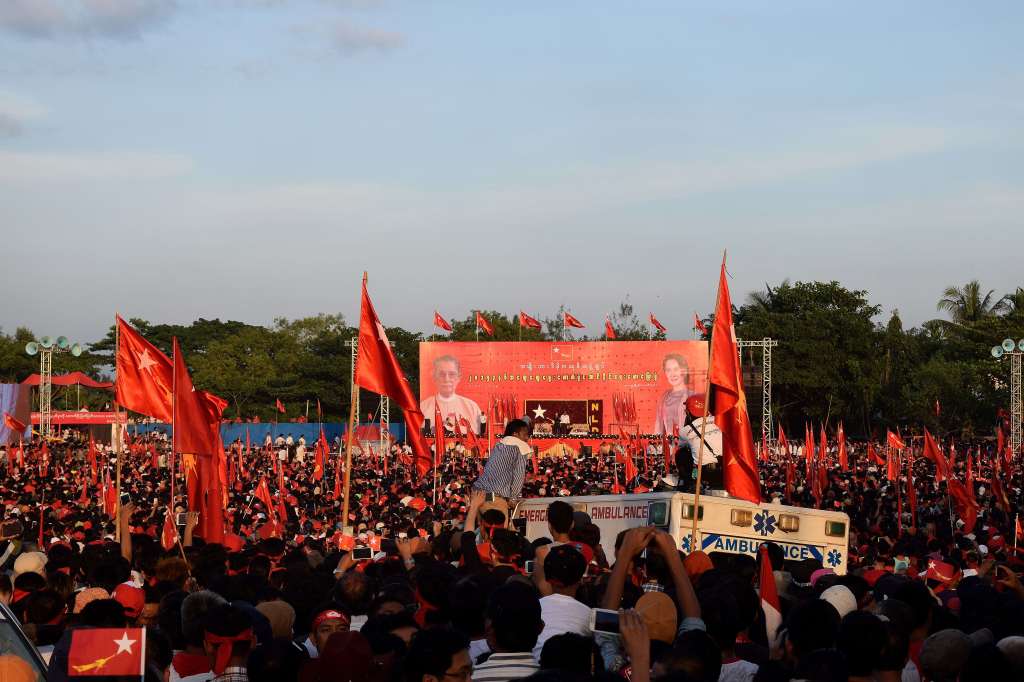
To me anyway, but probably to many Yangon residents, all of this was merely a crescendo that culminated in Aung San Suu Kyi’s great rally at Thuwanna Pagoda last Sunday – an election highlight that was widely reported in the international media. That was the first time I saw Myanmar’s greatest icon in person (an intimate moment, maybe, had it not been for the other 10,000 people attending). The rally was unlike anything I had ever experienced. Whereas during previous rallies people always maintained some reserve – as if wary of showing too much exuberance – they certainly were not holding back now. Held in a usually quiet Yangon suburb, the rally had completely crippled the traffic in that part of town. A friend and I made the remainder of our way by foot, breaking into a run once we heard Suu Kyi’s voice resounding throughout the neighbourhood. By the time we made it to the site, a huge crowd had already come together, sporting NLD t-shirts, headbands and stickers – a sea of red colour.

Courtesy of my height, I had a reasonably free view of the stage and could see the distant, slender figure of Aung San Suu Kyi, all clad in green. She was flanked by her deputy, U Tin Oo, an 87 year-old former general who suffered imprisonment and hard labour for throwing his weight behind ‘The Lady’ in the 1980s. I met U Tin Oo privately during my first stay in Myanmar three years ago and he could tell stories from a career stretching back all the way to serving in the colonial Burma Rifles regiment, at a time when Suu Kyis’ father – General Aung San – fought to secure the country’s independence in the 1940s.

Suu Kyi mesmerised the crowds but she also kept them entertained, making people laugh several times with quips on Myanmar’s ruling party, the USDP. The speech was entirely in Burmese but the reactions of Suu Kyi’s audience made it enchanting for me nevertheless. Wearing a red NLD t-shirt myself (decorated with a white star and the golden peacock of Myanmar’s student revolution) quickly turned me into something of a local celebrity: people everywhere greeted me with friendly nods or waves and on the way back from the rally I had to pose for about a dozen photos. The rally, feeling one with the crowd, created a moment of emotional connection for me. Walking back after the speech, hearing people sing ‘NLD must win’, I could finally identify with people’s aspirations not just rationally but emotionally. For an outsider, staying here for a mere three months, that is a truly precious moment!

DSS_0026_004

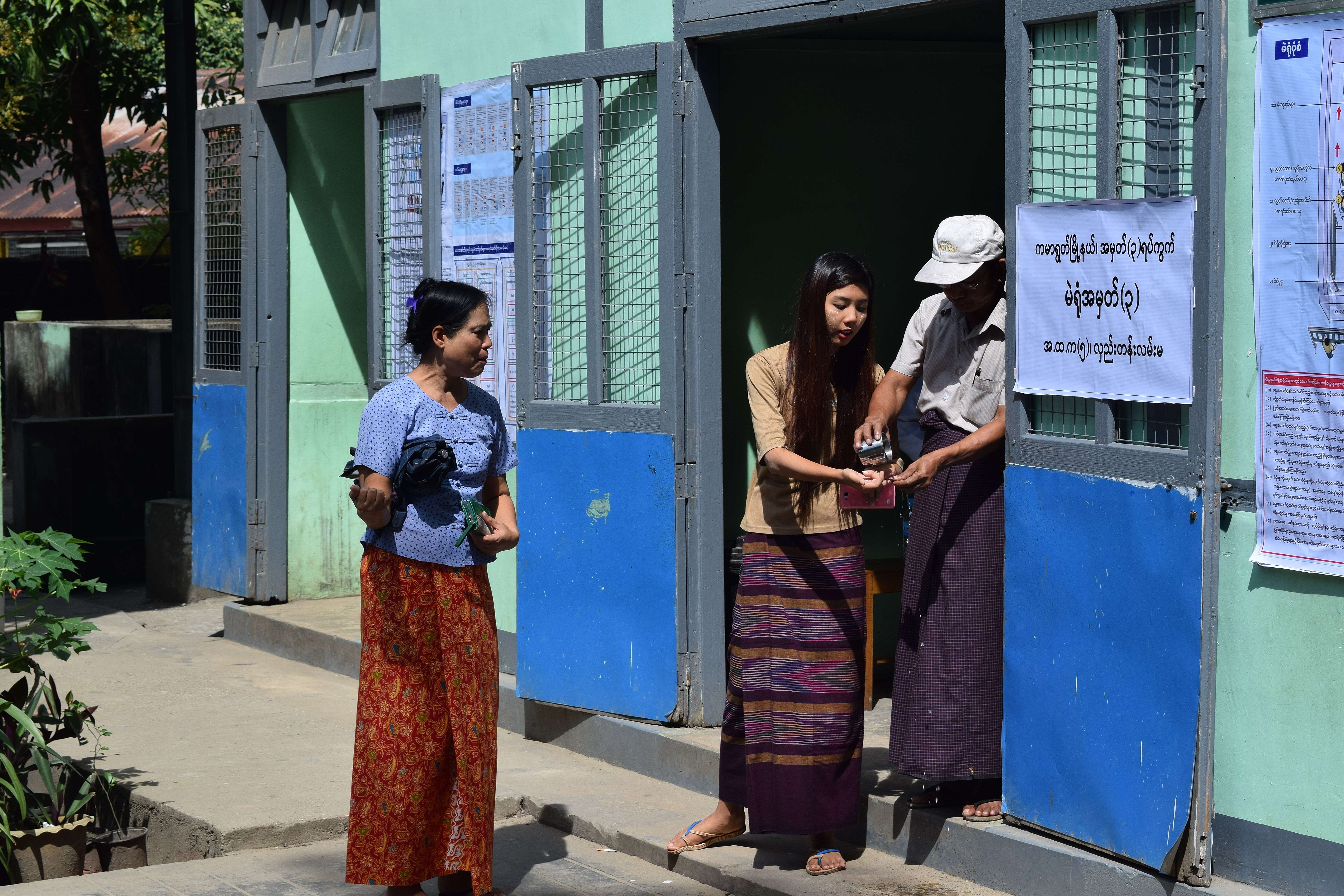
Today’s election day, on the other hand, seemed almost anticlimactic at times. Queues flocked together at the polling stations as early as 4am. Recovering from a bout of acute food poisoning, I literally did not have the stomach to join them. But by the time I started my own excursion to a polling station with two friends, the stream of voters had slowed to a trickle. Inside the voting stations though, my friends tell me, there were scenes of great excitement and of nervous diligence as older residents were scared of ‘getting it wrong’ in what might be the most important election of their lifetime. Waiting outside, I got to see some touching moments, most memorably among them two ladies sporting ethnic Shan hats and thickly made up in Myanmar’s thanaka paste. They left the voting station hand in hand, sharing in the joy of the moment and its accomplishment. And many of my friends here have been posting selfies, proudly presenting their ink-stained pinky fingers – #JustVoted, as the hashtag goes.
DSC_0763

Tonight, following my stint at the café, we rushed towards the NLD office where maybe a thousand people had gathered to celebrate the elections and listen to some of the first results being announced. The crowds were chanting an eclectic combination of songs, mixing folk music (oddly alike to what you might expect from Bavaria’s Oktoberfest) with the catchy tune that broadly translates as, ‘NLD must win, let’s erase the tyranny’.

But my account of this election would be sorely incomplete if I did not mention the shadows cast over these historic events. On the one hand, I have to mention Ma Ba Tha, the group of extremist Buddhist monks, who have increasingly thrown their weight behind the ruling party – a sad reversal of the days of 2007 when many monks marched against the military junta. Stoking the fire of Buddhist nationalism has become a new addition to the generals’ repertoire of divide-and-rule tactics. Many believe that the government has been tacitly encouraging religious violence in Myanmar’s Rakhine state. This is the same violence that prompted thousands of Rohingya to flee the country, the so-called ‘Boat People’ who briefly captured international headlines this spring. Whether Ma Ba Tha can hold the tide of opposition voting and unexpectedly boost the ruling party’s chances is unclear.

On the other hand, there are the concerns of Myanmar’s ethnic minorities which complicate today’s golden narrative. I have to mention this part of the story, not least since most of my closest friends in Myanmar come from exactly these areas which have been mired in violent conflict for decades. Some of my friends from these areas did not vote at all or indeed chose Aung San Suu Kyi’s NLD as a ‘lesser evil’. For them, today is not just a black-and-white decision about freedom and democracy. For them, democracy is in no way a guarantee that the concerns of their people will be heard, that conflict will cease, that justice will be done or indeed that resources will be shared fairly. And in the end, this is why all the ‘old hands’ experienced in Myanmar’s affairs like to reiterate that much work remains to be done once the ballots are counted.

Nevertheless, today is worth celebrating. The final results will take a little while longer but this much is clear: all the elections I have witnessed back in the UK or in Germany pale in comparison to the euphoria of the last few weeks and the promise which tomorrow may bring!
Lunching on Bank Street

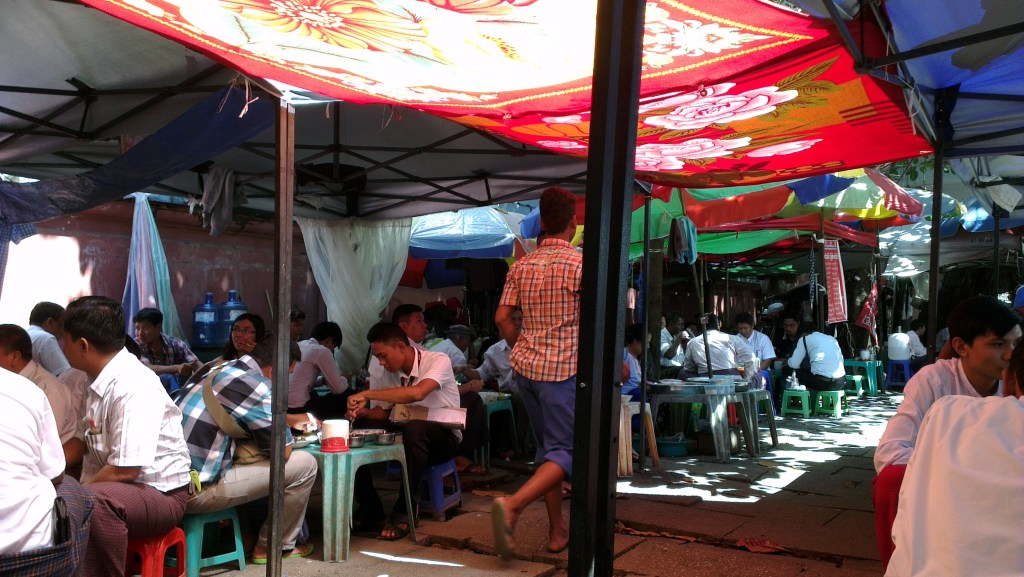
It is lunchtime and I leave the office of the Yangon Heritage Trust to head over to Bank Street, a shady little side alley lined with the monumental architecture of buildings that face out on Pansodan and Sule Pagoda Road. But Bank Street is not merely lined with colonial architecture. Spread across the pavements is a series of food stalls, each complete with tiny stools and tables in garish colours. 1800 Kyats, or 1.4 dollars, buy me a full portion of rice, a bowl of egg in tasty meat broth, some chicken, a platter of vegetables and chili dip, a bowl of soup, and unlimited refills of delicious green tea. Needless to say that each such meal presents me with a wider range of flavours than all of my native German cuisine taken together.

The waiters are fast and efficient but also friendly. My tea cup is never empty for any longer than twenty seconds – that kind of attentiveness would be hard to beat even for a five-star hotel. Other customers keep flocking in, most of them wearing the traditional longyi (a kind of chequered sarong) and a white shirt. Many of the other customers, I suspect, work at the nearby banks and government offices. Some of them also have a smile and a nod for me. I like to think it is a sign that they appreciate me sharing their lunch rather than treading the well-worn path to Sharky’s further up the street. Sharky (whose real name is U Ye Htut Win), a legend among Yangon’s expats, returned from twenty years in Switzerland to start an upmarket deli store in Yangon. In his new downtown branch, not five minutes away from my office, he adds artisan pizzas and salads to his offering of charcuterie and cheeses (all home-made here in Myanmar). While Sharky’s provides all the comforts of home and a welcome refuge during bouts of shaky bowels, lunching at Bank Street provides me with a much more riveting experience.

It is all too easy as an outsider to romanticise the poverty we encounter in countries like Burma. Is it not utterly charming? Does not the exoticism of deprivation satisfy our more voyeuristic instincts? But that is not the only possible response. If you ask me whether I want things in Bank Street to stay the same, I would answer, ‘Certainly not!’I want the staff of these charming roadside stalls to have access to comprehensive health care. I want the ugly appendix to the glamorous turrets of the district court to be demolished. I want the pavement, currently a forest of trip hazards, to be easily walkable for an old lady. I want the children who wait on so many of the tables on Bank Street to go to school.

But I also hope, I hope passionately, that the atmosphere which pervades Bank Street today can be preserved for decades to come. The easy joviality that comes from sharing lunch across those little plastic stools and tables which are densely packed together on the pavement*. The sense of community. The shade of the mighty trees which still line this street. Not to mention the flavours of the cuisine. Because all of this adds up to a truly precious experience.

Interestingly, I am not the only one to think so. The urban planning consultants who visited the Yangon Heritage Trust last week were just as struck. They promptly proposed that we might develop what is called an ‘area action plan’ for this street, one which would serve to preserve and share this experience which I enjoyed so thoroughly. And that way, we might not just save Yangon’s historical buildings but its unbuilt heritage which makes up the real character of this unique city.

In my last post, I mentioned why I came to Myanmar in the first place. But everyday experiences like lunch on Bank Street are the reason why I want to stay.

* I should add that, on reflection, it may have been the sight of a 1.95-metre white male perching on one of these 30cm stools that made the other customers smile at me.

A new chapter

The last two months brought with them all the trappings and emotions associated with starting a new phase in life. They were filled with the hassle of moving six years worth of possessions accumulated while living and studying in the UK. They involved meeting doctors, banks and insurance agents as well as acquiring scraps of a new language, Burmese. And for all my excitement there was also the occasional shortness of breath that reminded me that this transition was maybe a little more daunting than I had been admitting to myself.

All of this because, with four years at Cambridge behind me (as well as the thrill of two care-free holidays to mark the end of that particular era), I am now spending three months working in Myanmar.

Why Myanmar? Judging from the reactions I came across among friends and acquaintances, the country is maybe best known for its (former) military regime and the heroic struggle of democracy icon and Nobel laureate Aung San Suu Kyi. Travel aficionados might also know of a country supposedly locked in time, a country of monks and farmers flocking around golden pagodas.

The reality that attracted me to come here is even more interesting (and exotic?) than the stereotype. For Myanmar is doubtlessly at a turning point. It is only recently emerging from decades of isolation under a military regime that turned an incredibly cosmopolitan society (Yangon was the world’s busiest port back in the 1920s) into a backwater ridden by ethnic conflict.

Being here for nearly two weeks now feels like reaching a frontier, a place in transition where change is rapid and palpable. Since my first visit in 2012, ATMs have cropped up throughout Yangon. No longer do foreigners like myself have to carry bundles of US dollars into the country. Construction sites wherever you look mark a surge in foreign investment that has made Myanmar one of the fastest-growing economies in the world (how far this has trickled through to the country’s poor is quite another question). Before 2010, Aung San Suu Kyi was referred to, in hushed tones, just as ‘the Lady’. Now her image dangles from the mirrors of taxis and is plastered all over political rallies that feel more like joyous street festivals than solemn political assemblies.

And yet this transition is uncertain. Everything still hangs in the balance. How will the Tatmadaw (the Myanmar military) react if the Lady’s National League for Democracy wins by a landslide in the November elections? Will the country succeed in bringing prosperity to the countryside where most Burmese live? The countryside whose abject poverty continues to place Myanmar rock-bottom when rated for most human development indicators? These are open questions. Asking them elicits guarded hopefulness from most of the Burmese I have talked to, not unbridled optimism.

But for now, I am more interested how these big, political questions translate into the buzz of everyday life among an incredibly welcoming and entrepreneurial people. These are the impressions I am hoping to record with this blog. I am thinking of the young Burmese who was circulating feedback forms alongside bags of peanuts to impromptu focus groups in a Chinatown bar so that he could refine his recipe and make a business out of it. I am also thinking of the Buddhist monk who roped me into a spontaneous conversation class with 30 Burmese university students (all of whom, after three years studying supposedly English-language courses, had to start learning the language from scratch at a private school). And of course, I am thinking of the wonderful friends I have made here, many of them working at local NGOs that represent a real flowering of civil society.

To me, this jumble of impressions sums up why I am excited to be in Myanmar. Check back here for regular updates and photos!