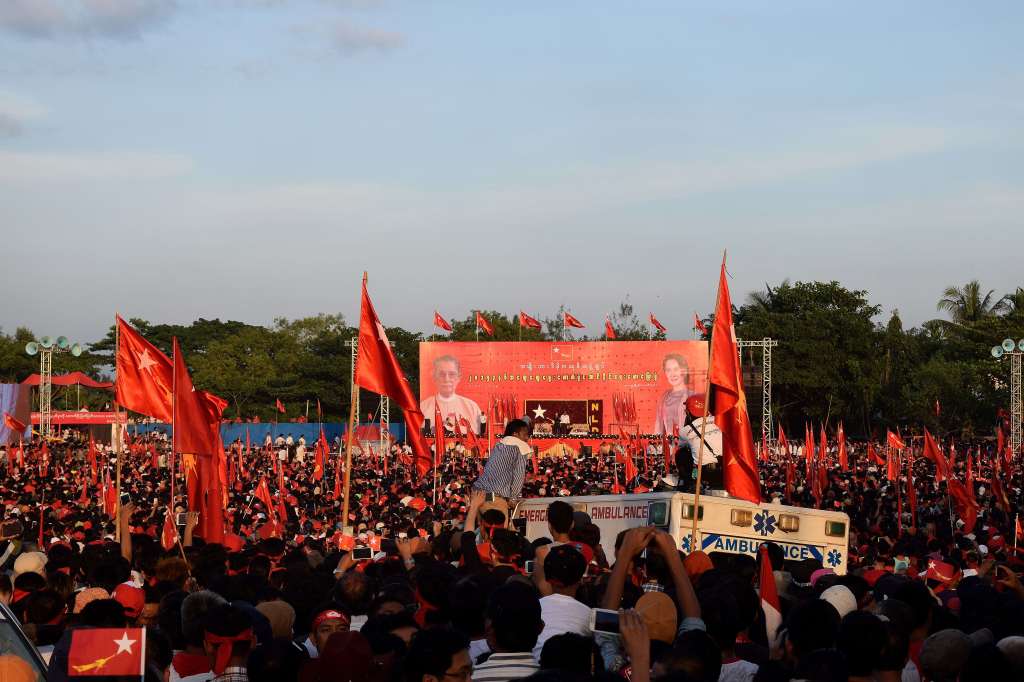
Today has been a landmark moment in Myanmar’s history: the first openly contested elections in Myanmar since 1990 when nobel laureate Aung San Suu Kyi won a landslide victory which the military junta proceeded to ignore.
Although the rain season is officially over, it was pourindg down for much of the afternoon, trapping me in one of Yangon’s cafés and providing the perfect moment to collect my thoughts and impressions about Myanmar’s historic election.
All I have to offer is a patchwork of impressions, gained from living in Yangon and occasionally venturing to campaign events in Myanmar’s largest city. This part of my Yangon experience began in September, when I occasionally saw small rallies while walking to my office downtown. All of them would feature loud music and frequently live bands, and groups of pedestrians would come and ‘stop and stare’ for a while. More and more, the campaign trailers of various parties – usually a kind of double-decker featuring garish colours, lavish imagery of the candidates and huge speakers – became part of everyday life in the city. The tinny sounds of catchy party tunes and local pop hits became a regular distraction in our office, and in the evenings, when greater crowds could be summoned, these turned into spontaneous street concerts.


To me anyway, but probably to many Yangon residents, all of this was merely a crescendo that culminated in Aung San Suu Kyi’s great rally at Thuwanna Pagoda last Sunday – an election highlight that was widely reported in the international media. That was the first time I saw Myanmar’s greatest icon in person (an intimate moment, maybe, had it not been for the other 10,000 people attending). The rally was unlike anything I had ever experienced. Whereas during previous rallies people always maintained some reserve – as if wary of showing too much exuberance – they certainly were not holding back now. Held in a usually quiet Yangon suburb, the rally had completely crippled the traffic in that part of town. A friend and I made the remainder of our way by foot, breaking into a run once we heard Suu Kyi’s voice resounding throughout the neighbourhood. By the time we made it to the site, a huge crowd had already come together, sporting NLD t-shirts, headbands and stickers – a sea of red colour.
Courtesy of my height, I had a reasonably free view of the stage and could see the distant, slender figure of Aung San Suu Kyi, all clad in green. She was flanked by her deputy, U Tin Oo, an 87 year-old former general who suffered imprisonment and hard labour for throwing his weight behind ‘The Lady’ in the 1980s. I met U Tin Oo privately during my first stay in Myanmar three years ago and he could tell stories from a career stretching back all the way to serving in the colonial Burma Rifles regiment, at a time when Suu Kyis’ father – General Aung San – fought to secure the country’s independence in the 1940s.
Suu Kyi mesmerised the crowds but she also kept them entertained, making people laugh several times with quips on Myanmar’s ruling party, the USDP. The speech was entirely in Burmese but the reactions of Suu Kyi’s audience made it enchanting for me nevertheless. Wearing a red NLD t-shirt myself (decorated with a white star and the golden peacock of Myanmar’s student revolution) quickly turned me into something of a local celebrity: people everywhere greeted me with friendly nods or waves and on the way back from the rally I had to pose for about a dozen photos. The rally, feeling one with the crowd, created a moment of emotional connection for me. Walking back after the speech, hearing people sing ‘NLD must win’, I could finally identify with people’s aspirations not just rationally but emotionally. For an outsider, staying here for a mere three months, that is a truly precious moment!

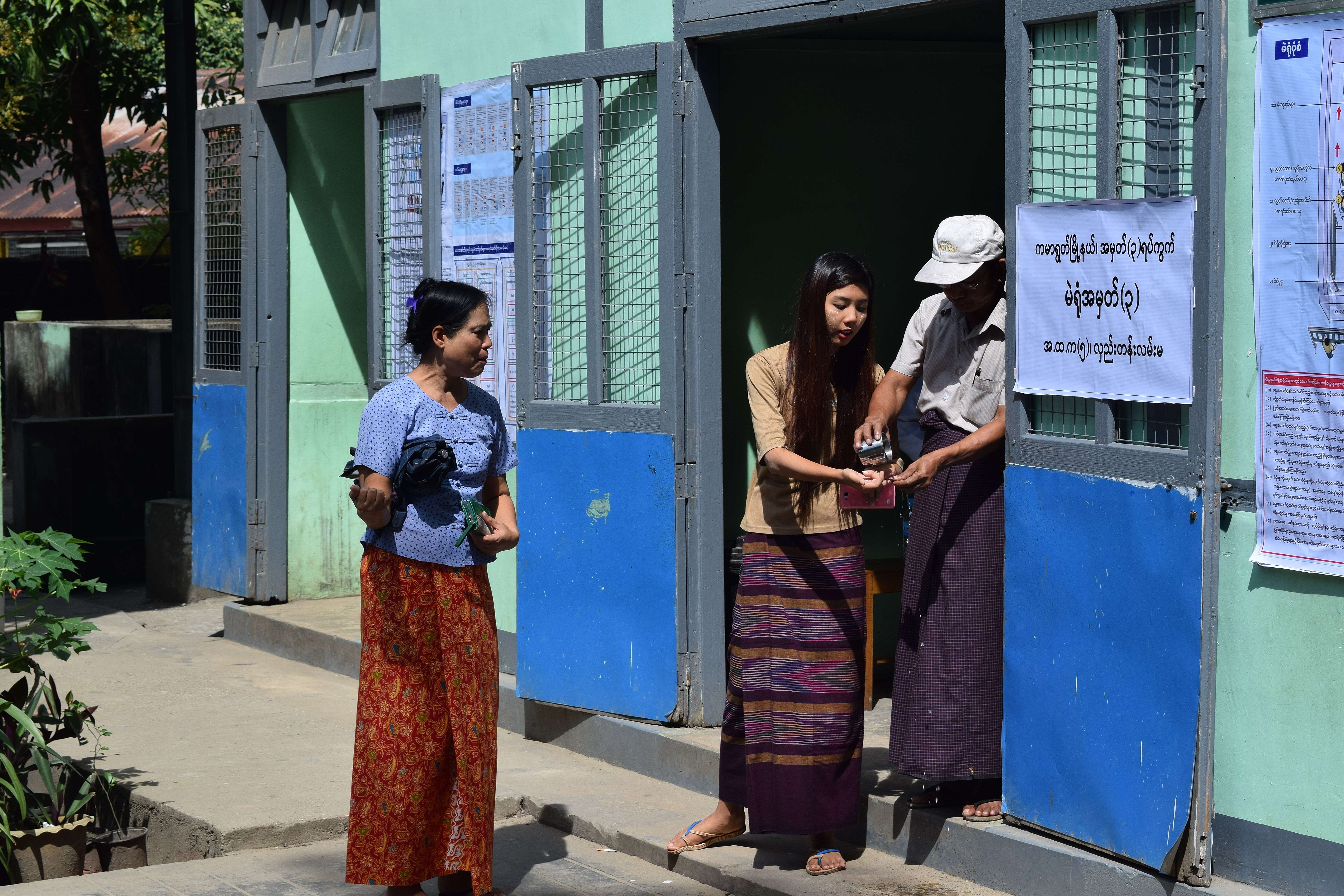
Today’s election day, on the other hand, seemed almost anticlimactic at times. Queues flocked together at the polling stations as early as 4am. Recovering from a bout of acute food poisoning, I literally did not have the stomach to join them. But by the time I started my own excursion to a polling station with two friends, the stream of voters had slowed to a trickle. Inside the voting stations though, my friends tell me, there were scenes of great excitement and of nervous diligence as older residents were scared of ‘getting it wrong’ in what might be the most important election of their lifetime. Waiting outside, I got to see some touching moments, most memorably among them two ladies sporting ethnic Shan hats and thickly made up in Myanmar’s thanaka paste. They left the voting station hand in hand, sharing in the joy of the moment and its accomplishment. And many of my friends here have been posting selfies, proudly presenting their ink-stained pinky fingers – #JustVoted, as the hashtag goes.
Tonight, following my stint at the café, we rushed towards the NLD office where maybe a thousand people had gathered to celebrate the elections and listen to some of the first results being announced. The crowds were chanting an eclectic combination of songs, mixing folk music (oddly alike to what you might expect from Bavaria’s Oktoberfest) with the catchy tune that broadly translates as, ‘NLD must win, let’s erase the tyranny’.
But my account of this election would be sorely incomplete if I did not mention the shadows cast over these historic events. On the one hand, I have to mention Ma Ba Tha, the group of extremist Buddhist monks, who have increasingly thrown their weight behind the ruling party – a sad reversal of the days of 2007 when many monks marched against the military junta. Stoking the fire of Buddhist nationalism has become a new addition to the generals’ repertoire of divide-and-rule tactics. Many believe that the government has been tacitly encouraging religious violence in Myanmar’s Rakhine state. This is the same violence that prompted thousands of Rohingya to flee the country, the so-called ‘Boat People’ who briefly captured international headlines this spring. Whether Ma Ba Tha can hold the tide of opposition voting and unexpectedly boost the ruling party’s chances is unclear.
On the other hand, there are the concerns of Myanmar’s ethnic minorities which complicate today’s golden narrative. I have to mention this part of the story, not least since most of my closest friends in Myanmar come from exactly these areas which have been mired in violent conflict for decades. Some of my friends from these areas did not vote at all or indeed chose Aung San Suu Kyi’s NLD as a ‘lesser evil’. For them, today is not just a black-and-white decision about freedom and democracy. For them, democracy is in no way a guarantee that the concerns of their people will be heard, that conflict will cease, that justice will be done or indeed that resources will be shared fairly. And in the end, this is why all the ‘old hands’ experienced in Myanmar’s affairs like to reiterate that much work remains to be done once the ballots are counted.
Nevertheless, today is worth celebrating. The final results will take a little while longer but this much is clear: all the elections I have witnessed back in the UK or in Germany pale in comparison to the euphoria of the last few weeks and the promise which tomorrow may bring!
 Burmese Tales